
How many units does a solar system produce per day in Pakistan? As a working rule, each kilowatt of well installed panels produces about 4 to 5 units a day averaged across the year. That means solar system units per day range from roughly 3.5 units per kW on a hazy Punjab winter day to around 6.5 in spring, and higher still in sunnier parts of Sindh and Balochistan.
Alphasolar uses these figures every day to size systems and to check whether a customer’s existing system is underperforming. This guide gives you the numbers for every common system size, explains why your meter may show less than the brochure promised, and shows how to use daily units to choose the right system.
Key Takeaways
- Rule of thumb: 1kW of solar produces about 4 to 5 units a day on average, which is 120 to 150 units a month.
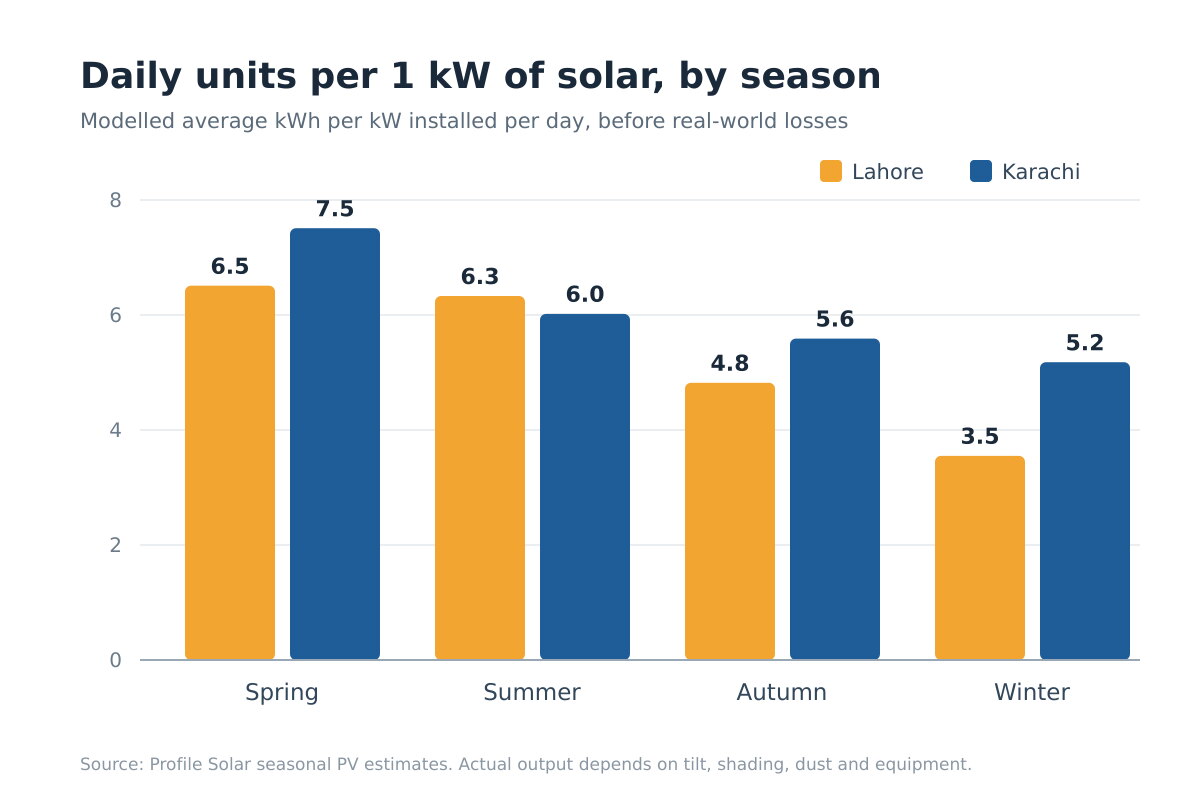
- Seasons matter: modelled output in Lahore ranges from about 6.5 units per kW in spring to about 3.5 in winter.
- 10kW solar system units per month typically total 1,200 to 1,500, or 40 to 50 units a day.
- Real losses from heat, dust, wiring and the inverter usually take 15 to 20 percent off the ideal figure.
- Under net billing, size to what you can use during daylight rather than to the size of your roof.
How Many Units Does 1kW of Solar Produce Per Day?
One unit on your electricity bill is one kilowatt hour. A 1kW array produces one unit for every hour it works at full rated output. Panels rarely do that, so installers think in peak sun hours: the number of hours of full strength sunlight a location receives in a day.
Peak sun hours in Pakistan typically range from about 5 to 6 a day. Real systems lose part of that to heat, dust, cable resistance and inverter conversion, so 1kW solar panel units per day land at about 4 to 5 across the year. Published estimates put annual solar generation per kW in Pakistan at roughly 1,400 to 2,200 units, depending on location. You can check your exact location on the Global Solar Atlas.
How do seasons change daily units?
Seasonal modelling for Lahore suggests about 6.5 units per kW per day in spring, 6.3 in summer, 4.8 in autumn and 3.5 in winter. Karachi is steadier through the year, at roughly 7.5 in spring, 6.0 in summer, 5.6 in autumn and 5.2 in winter. Karachi’s summer dip comes from monsoon cloud, while Punjab’s winter dip comes from shorter days, low sun and smog.
That winter gap matters if you live in Lahore, Faisalabad, Gujranwala or Multan. Our guide to solar output in a Punjab winter explains why cold weather itself is not the problem, and our city by city solar guide covers regional differences in more detail.
Solar System Units Per Day by System Size
The table below shows solar system units per day using the practical range of 4 to 5 units per kW per day for the annual average, and about 3 to 3.5 units per kW for a clear Punjab winter day. Foggy or heavily polluted days can fall below this.
| System size | Average units per day | Average units per month | Clear winter day, Punjab |
|---|---|---|---|
| 1kW | 4 to 5 | 120 to 150 | 3 to 3.5 |
| 3kW | 12 to 15 | 360 to 450 | 9 to 10.5 |
| 5kW | 20 to 25 | 600 to 750 | 15 to 17.5 |
| 6kW | 24 to 30 | 720 to 900 | 18 to 21 |
| 8kW | 32 to 40 | 960 to 1,200 | 24 to 28 |
| 10kW | 40 to 50 | 1,200 to 1,500 | 30 to 35 |
| 12kW | 48 to 60 | 1,440 to 1,800 | 36 to 42 |
| 15kW | 60 to 75 | 1,800 to 2,250 | 45 to 52 |
| 20kW | 80 to 100 | 2,400 to 3,000 | 60 to 70 |
If you are weighing a whole house system, our new guide to the 15kW solar system price in Pakistan puts these units next to current costs. Smaller and mid sized systems are covered on our 3kW, 5kW, 6kW and 10kW price pages.
Why Does My Solar System Produce Fewer Units Than Expected?
When a customer calls Alphasolar about low output, the cause is almost always one of five things.
Dust and bird droppings
Pakistan’s dust settles fast. A film you can barely see can cost 5 to 10 percent of output, and heavy build up after a dust storm can cost far more. Read our guide to solar panel cleaning and maintenance, or book our solar panel cleaning services in Lahore.
Heat
Panels lose roughly 0.3 to 0.4 percent of output for every degree their cells run above 25°C. On a 45°C June afternoon, cell temperatures can exceed 65°C. An elevated structure with airflow under the panels helps, which is one reason we care about solar mounting structures.
Shading, tilt and orientation
A water tank, a neighbour’s floor or a parapet wall can shade one panel and drag down a whole string. Panels should face south, with a tilt near your latitude, roughly 25 to 30 degrees across most of Punjab.
Inverter limits and faults
An undersized inverter clips midday peaks. A tripped string, a loose connector or a failing inverter can cut output with no visible sign. Our article on solar inverter problems covers the warning signs, and our common inverter problems and solutions guide explains basic fixes.
Panel quality and age
Good panels lose well under 1 percent a year. Poorly documented or B grade stock can degrade far faster. See our advice on used and B grade solar panels.
How Do You Use Daily Units to Size a Solar System?
Start from your consumption, not from the space on your roof. Under the February 2026 net billing rules, exported units are credited at a buyback rate reported at around Rs 11, far below the retail tariff you pay for imported units. Our article on net metering to net billing explains the change. In practice, that makes self consumption the target.
- Collect 12 months of units from your electricity bills.
- Work out your average daily units, and separately estimate how many of them are used in daylight.
- Divide your daylight units by about 4.5 to get the system size that covers them.
- Add battery storage only if your evening load or outages justify it.
For a quick estimate, try our solar calculator, or read how many solar panels do I need. Ready made configurations are listed on our solar packages page.
How Can You Check Your System Is Producing Enough?
Open your inverter’s monitoring app at the end of a clear day and compare your solar system units per day with the table above. If the result keeps falling more than 20 percent short, clean the panels first. If the gap remains, book an inspection. Alphasolar’s solar system inspection service checks strings, connectors, earthing and inverter logs, and our solar services team can repair systems installed by other companies too.
Get a Generation Estimate for Your Roof
Every roof is different. Share a recent bill and a few photos of your roof, and Alphasolar will estimate your daily and monthly units before recommending any system. Request a free quote to get started.
Frequently Asked Questions
How many units does a 1kW solar system produce per day in Pakistan?
About 4 to 5 units a day averaged over the year. Spring and summer days can exceed 6 units, while foggy winter days in Punjab can drop to 3 units or less.
How many units does a 10kW solar system produce per month?
Roughly 1,200 to 1,500 units a month on average in most Pakistani cities, with higher totals in spring and summer and lower totals in December and January.
How many units does a 5kW solar system produce per day?
About 20 to 25 units a day averaged over the year, which is roughly 600 to 750 units a month.
Why is my solar system producing fewer units in winter?
Shorter days, a lower sun angle, fog and smog reduce the sunlight reaching your panels. Cold itself actually helps panel efficiency. Cleaning panels and adjusting tilt can recover part of the loss.
What are peak sun hours in Pakistan?
Most of Pakistan receives the equivalent of about 5 to 6 hours of full strength sunlight a day. After real world losses, that translates into roughly 4 to 5 units per installed kilowatt per day.