
Cheap panels are everywhere in Pakistan, and some are fine. Nothing on the outside of a module tells you which. A used panel, a B grade panel and a genuine A grade panel sit on the same pallet looking identical.
Two documents separate them: a flash test report and an electroluminescence image. Without either, you are buying on trust. Alphasolar sells new A grade stock, and this guide works for any panel, including one bought elsewhere.
Key Takeaways
What settles it? A flash test report for electrical output, and an EL image for hidden cell damage.
What does B grade mean? Usually a module that failed a factory check and left through a side channel.
How fast do panels age? Crystalline silicon loses roughly 0.5 to 1.9 percent a year.
Where do used panels fit? Low stakes off grid work, not a rooftop you want certified.
Why Is Pakistan Full of Cheap Panels Right Now?
Because far more modules arrived than the country could install.
Pakistan imported around 13 gigawatts of Chinese modules in the first half of 2024, against roughly 3.5 gigawatts of demand across all of 2023, making it the third largest market for Chinese module exports. That surplus did not evaporate. It sat in warehouses, moved through traders, and pushed margins to nothing. A glut is good for buyers of genuine stock and very good for anyone selling something else, because when the real thing is cheap, relabelled modules hide easily beside it. Our guide to solar panel brands in Pakistan covers which manufacturers to ask for by name.
What Does B Grade Actually Mean?
It is not a formal classification, which is the first thing to understand.
In practice a B grade module failed a manufacturer’s check and left through a side channel. The reason might be cosmetic, a scratch or misaligned cell, or electrical, a module that binned below its label. You cannot tell which from the outside, and the seller may not know either.
The problem in Pakistan is not that B grade stock exists, it is that it gets sold as A grade. LONGi has publicly said its brand name is being misused to sell subpar products, and industry figures point buyers toward registered installers and authorised dealers. Alphasolar quotes the manufacturer and the supply route, not just a wattage.
How Do You Read a Flash Test Report?
It is the module’s electrical result under controlled conditions, and the most useful document a seller can hand you. A flash test fires a xenon lamp at the module under Standard Test Conditions: 1,000 watts per square metre, 25 degrees cell temperature, AM 1.5G spectrum. It records maximum power, open circuit voltage, short circuit current, the values at maximum power, and fill factor.
| What to check | What good looks like | What it means |
|---|---|---|
| Maximum power | At or above the label rating | The module makes what it claims |
| Open circuit voltage | Within about 1 percent of datasheet | Cells and wiring are intact |
| Fill factor, TOPCon or PERC | About 80 or 78 percent and up | Normal internal resistance |
| Fill factor, any type | Below 75 percent is a red flag | Hidden resistive or cell damage |
| Serial number | Matches the module label | The report belongs to this panel |
That last row matters more than people expect. A flash report for a different module is worth nothing, so Alphasolar checks serials against the physical panel. Modules are also sorted into power bins, often five watts wide, so one may test slightly under its label and still carry it. Asking for a zero to plus tolerance means nothing falls below its rating.
What Does an EL Image Show You?
Everything the flash report cannot, because it looks inside the cells.
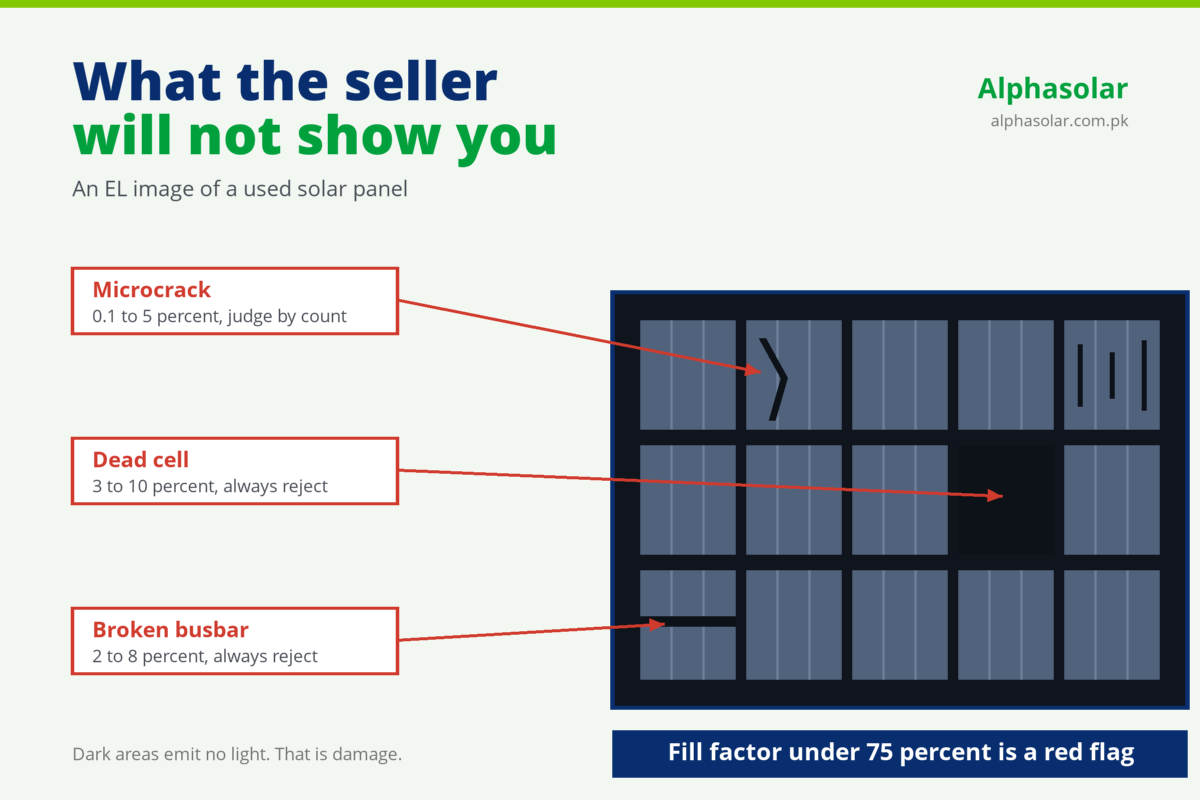
An electroluminescence test runs current backwards through the module in a dark room. The cells emit near infrared light, a camera captures it, and damaged areas show dark. It is the closest thing to an X ray for a panel, and Alphasolar treats it as the deciding document on a module of unknown history.
- Connected microcracks cost very little, roughly 0.1 to 1 percent
- Microcracks isolating part of a cell cost roughly 1 to 5 percent on it
- Finger interruptions, thin dark lines beside the busbars, cost roughly 0.1 to 0.5 percent
- A broken busbar shows as a dark line across the cell rows, roughly 2 to 8 percent
- A dead cell, more than a third of its area emitting nothing, costs roughly 3 to 10 percent
The working rule: accept isolated inactive cracks, reject a module with more than about three, reject any crack crossing between cells, and reject a dead cell or broken busbar outright. Alphasolar applies that standard rather than a visual glance.
How Much Output Has a Used Panel Already Lost?
More than the seller will say, and the honest answer is a range.
Crystalline silicon is generally assumed to lose up to about 1 percent a year, though laboratory studies across real fleets put the spread at roughly 0.5 to 1.9 percent. Climate, encapsulant, mounting and system voltage all move it, and Pakistani rooftops sit at the harsher end on heat and dust.
Work the arithmetic before a discount impresses you. A module eight years into service at the bad end of that range has lost a meaningful slice of its output, and you are buying the remaining life, not the label. Alphasolar asks customers to do that sum before comparing against new stock in our solar panels range.
What Can You Check Without a Lab?
A surprising amount, all of it in daylight.
Start with the label. Photograph front and back, read the model and serial number, pull the datasheet and compare the electrical values. Certificates can be checked against the issuing body’s register rather than taken at face value.
Then look at the module, cleaned, around midday:
- Cracked glass, which means recycling rather than your roof
- Snail trails, burn marks and hotspot discolouration
- Browning or milky patches in the encapsulant, bubbles or delamination
- Cracks in the backsheet, which let moisture in
- Corrosion at the junction box or busbars, perished cable insulation, damaged connectors
Then take readings. A multimeter gives open circuit voltage and short circuit current, and both should sit close to the datasheet. Any condition above is a reason to send the module for testing. Alphasolar can inspect panels a customer has already bought and say plainly what is there.
Does the Warranty Survive the Sale?
Usually not in any form you can rely on, and that is where most of the saving goes.
A performance warranty is written against an original purchase and a known installation. Once a module has passed through an open market trader, the paperwork chain a claim depends on is broken, and the warranty is only as good as whoever sold it to you. If that is a trader rather than a registered company, you have none.
Ask three questions in writing: who honours the warranty, for how long, and what a claim needs. If the answers are vague, treat the panel as uncovered. Alphasolar supplies warranty terms with the quotation, and our solar services page sets out what support looks like afterwards.
Where Do Used Panels Genuinely Make Sense?
Where a failure costs very little and nobody has to certify the result. A net billing application involves inspection of the finished installation, and a module with no verifiable serial, certificate or clear origin is a problem then. Our guide to net metering and net billing explains what the approval checks.
Off grid work is the honest use case: a pumping setup, a shed, a boundary light, a village installation where a dead module can simply be swapped. Alphasolar quotes that work under village solar solutions and agriculture solar solutions, and a solar charge controller build tolerates mixed modules better than a string inverter.
They do not suit a grid connected rooftop you intend to register, a roof you do not want to open twice, or any array where one weak module drags a string. Structure, labour and wiring cost the same whatever you bolt to them, which is the argument against saving on the component that must last twenty five years. Our guide to solar mounting structures covers that fixed cost.
Where Is This Market Most Active in Pakistan?
Lahore and Karachi, where import volume lands and trading density is highest. Buyers in both meet the widest choice and the widest spread of quality, and the two travel together.
Rawalpindi and Islamabad see more of it through contractor channels than open counters. In Faisalabad, Gujranwala and Sialkot demand follows the industrial base, where larger arrays make the saving tempting. Across southern Punjab and interior Sindh the pull is agricultural, and cheap modules often land on pumping sites where, handled knowingly, they are fine. Alphasolar installs across all of these, and recent Alphasolar work is on our projects page.
Quick Answers on Used Solar Panels in Pakistan
- A flash test report and an EL image are the two documents that matter, covering electrical output and hidden cell damage.
- A fill factor below 75 percent is a red flag, and anything above 85 percent on a standard module suggests the report is not genuine.
- Open circuit voltage should sit within about 1 percent of the manufacturer datasheet for that model.
- Crystalline silicon loses roughly 0.5 to 1.9 percent a year, so a used module arrives with part of its life spent.
- Alphasolar checks serial numbers against the physical panel, because a flash report for a different module proves nothing.
People Also Ask
Are used solar panels worth buying in Pakistan? For off grid work, sometimes. For a grid connected rooftop you intend to register, the saving rarely covers the lost warranty and certainty.
How can I tell if a solar panel is B grade? Usually not by eye. Ask for the flash test report and an EL image, then check the serial number on the report against the panel.
Do second hand panels still make full power? No. Crystalline silicon degrades by roughly 0.5 to 1.9 percent a year, so output depends on age, climate and previous mounting.
Can I mix used and new panels? Only with care. Mismatched modules in a string pull each other down, so keep them on separate inputs or a separate controller.
FAQs
I already bought panels from the market. Can you check them? Yes. Alphasolar can inspect them, take readings, and advise whether lab testing is worth it before anything goes on a roof.
Does a cheaper panel change the rest of my quote? Barely, and that is the point. Structure, wiring, protections and labour stay the same, so the saving applies to one line while the risk applies to the whole system. Configurations are on our solar packages page, and easy installments or solar financing spread the cost.
Ask for the Report Before You Pay
Send Alphasolar the make, model and a photo of the label of any panel you are considering, including one offered by someone else, and Alphasolar will tell you what to ask the seller for and what good answers look like. To start with new stock, begin at get a quote or read more on about us.

Leave A Comment