
Every December the same message arrives. The system was fine all summer, the bill has gone up, and the owner assumes cold has weakened the panels.
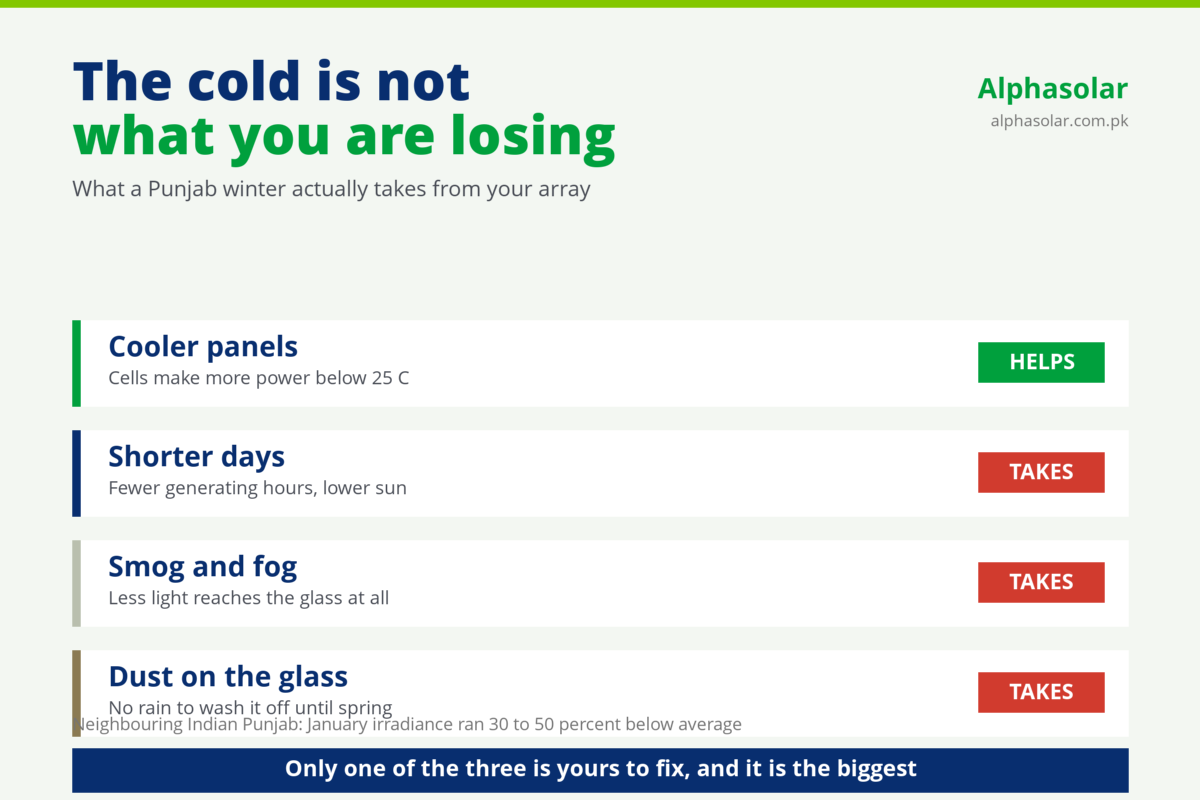
It has not. Cold air makes a panel work better, not worse. Three other things are taking your December output, and only one is in your control. Alphasolar sets this expectation before installation, not after the first winter bill.
Key Takeaways
Does cold hurt output? No. Panels produce more power per unit of light when they are cool.
So what drops? Daylight hours, sun angle, haze in the air, and dust on the glass.
How bad is the haze? Neighbouring Indian Punjab saw January irradiance fall 30 to 50 percent below average.
Which loss can you fix? The dust. It is also the largest single share.
Does Cold Weather Reduce Solar Output?
No. It improves it, and the datasheet says so.
Every panel is rated at Standard Test Conditions, which assume a cell temperature of 25 degrees. The datasheet carries a maximum power temperature coefficient, a negative number telling you what each degree above or below 25 does. Real modules sit near minus 0.29 percent per degree for TOPCon and around minus 0.255 for HJT.
Negative means output falls as the cell heats and rises as it cools. Take a 400 watt module at minus 0.38 percent per degree. At a 65 degree cell temperature, a normal Lahore rooftop in June, it makes about 339 watts. At a 5 degree cell temperature it makes about 430 watts. The January panel is the stronger panel.
That is why Alphasolar does not accept the cold as an explanation when a customer reports a winter drop. Something else is happening.
Why Does the Bill Rise in December Then?
Because four things change at once, and three of them work against you.
| What changes in January | Direction | Effect on your output |
|---|---|---|
| Cell temperature | Falls | Helps, panels work better when cool |
| Daylight hours | Shorter | Fewer hours of generation |
| Sun angle | Lower | Light passes through more atmosphere |
| Haze and fog | Heavier | Less light reaches the glass |
| Dust on the panel | Builds up | No rain to wash it off |
| Household load | Rises | Heating and geysers draw more |
The cold is the only line helping you, and it is outvoted. Add a heavier evening load and a bill that looked settled in September starts climbing. Alphasolar walks through this at handover so the first winter is not a surprise.
How Much Does Smog Actually Take?
More than most owners would guess, and there is a measured figure from next door.
In January 2024, irradiance across northern India, including Indian Punjab, Haryana and Uttar Pradesh, ran 30 to 50 percent below the long term average. Some localities had fog or smog lasting up to twenty days. Pakistani Punjab sits in the same airshed on the same plain in the same season, so treat that as the shape of the problem rather than an exact local figure.
Lahore’s own numbers show the scale. November is consistently the worst month. In November 2024 the city reached 1,067 on the air quality index, with parts of Mall Road and Samanabad far higher. November 2023 held around 400 long enough to close schools and offices. Crop burning, vehicles and industry feed it, and a temperature inversion traps the result over the city.
Is It the Haze or the Dust on the Glass?
Both, and the split matters because only one is yours to fix.
Research across heavily polluted and desert regions finds particulate matter can cut generation by more than half where panels are never cleaned and only rain removes anything. Soiling on the glass accounts for more than two thirds of that total. Atmospheric haze is the smaller share.
That is good news. You cannot clear the air over Lahore, but you can clear your own glass, and the larger slice of the loss sits on your roof. Alphasolar treats smog season as a cleaning schedule question first and a sizing question second. Our guide to solar panel cleaning and maintenance covers the method.
How Often Should You Clean in Smog Season?
More often than the rest of the year, because the one thing that normally cleans your panels has stopped.
Through the monsoon, rain does most of the work and a quarterly wash is usually enough. From November to February there is little rain across the Punjab plains, and smog deposits a fine greasy film rather than loose dust. That film does not blow off, and it bonds to the glass in a way plain dust does not.
Alphasolar moves customers to a tighter interval through those months and checks the array when the season ends. Two cautions: never clean a hot panel with cold water, and never use anything abrasive on the glass. If the roof is awkward or the array elevated, have someone do it who is equipped for the height.
Why Does an Inverter Trip on a Cold Morning?
Because voltage climbs as temperature falls, and a string sized for summer can exceed its limit in January.
The datasheet carries a second coefficient for open circuit voltage, also negative, often near minus 0.24 percent per degree. Run it backwards on a cold morning and the numbers move further than people expect. A module rated at 38.8 volts open circuit reaches roughly 43 at a very cold design temperature. Multiply that across a long string and you can pass the inverter’s maximum input voltage before the sun is properly up.
This is why string length is designed against the coldest morning of the year, not the hottest afternoon. It is also why a system assembled from panel count alone can run fine all summer and fault in winter. Alphasolar sizes strings against the cold case, and our solar inverters range lists the input windows that decision depends on.
What Should You Actually Expect in January?
Less than June, and that is normal rather than a fault.
A correctly built system in the Punjab plains produces noticeably less through December and January than in May. Shorter days and a lower sun are features of the season, not defects. What is not normal is a sudden drop, output that does not recover after a clean, or a system that was fine last winter and is weak this one.
The honest test is the same month last year, not summer. If this January is well below last January on a clean array, something has changed. Alphasolar can check an existing system and say which of the four causes is responsible.
Should You Size for Winter or Summer?
For your consumption, with winter understood rather than designed around.
Sizing so January alone covers a full bill means buying capacity that spills surplus for eight months, and under net billing that surplus earns a reduced rate. Alphasolar sizes against real annual consumption, accepts a winter shortfall, and treats storage or load shifting as a separate decision.
Our guides to the 6kW solar system and the 10kW solar system work through sizing, the solar calculator gives a starting point from your monthly units, and our guide to net metering and net billing explains why surplus is worth less than it was.
Does a Battery Help Through Winter?
It shifts your generation, which is a different thing from making more of it.
A battery lets a short winter generation window cover an evening load instead of exporting at midday and importing at night, which is useful under net billing. What it cannot do is manufacture units the array never produced, so a battery bought to fix a winter shortfall disappoints if the array is too small or too dirty.
Alphasolar sizes storage against the evening loads a customer actually wants covered, which is the same method used in our guide to lithium battery price in Pakistan. Clean the array and check the strings first. Buy storage for the right reason second.
Which Parts of Pakistan Lose the Most?
The Punjab plains, by a wide margin, and for a combination of reasons rather than one.
Lahore, Sheikhupura, Faisalabad and Gujranwala sit under the worst of the November and December inversion, and they also get the lowest winter sun and the least winter rain. Sialkot and Gujrat follow. Islamabad and Rawalpindi take a lower sun angle and genuine fog but less of the industrial loading. Multan and Bahawalpur fare better on haze and keep more winter sun.
Karachi and the coastal belt lose least, with a milder season and higher winter sun, though salt and dust still coat the glass. Interior Sindh and Balochistan keep strong winter irradiance and lose to dust rather than air. In the north, cold helps output while snow and shading are the real constraints. Alphasolar installs across all of these and quotes the seasonal picture by location. Recent Alphasolar work is on our projects page.
Quick Answers on Solar Output in Winter in Pakistan
- Cold improves panel output, because the maximum power temperature coefficient is negative and cells work better below 25 degrees.
- Winter losses come from shorter days, a lower sun, haze and dust, not from low temperature.
- Irradiance in neighbouring Indian Punjab ran 30 to 50 percent below average in January 2024, with fog or smog lasting up to twenty days in places.
- Soiling accounts for more than two thirds of particulate related loss, so cleaning is the biggest lever you control.
- Cold mornings raise open circuit voltage, which is why Alphasolar sizes strings against the coldest morning rather than the hottest afternoon.
- Compare January against last January, not against June, when judging whether a system has a real fault.
People Also Ask
Do solar panels work in fog in Pakistan? Yes, but output falls sharply. Dense fog and smog scatter light before it reaches the glass, which is why Punjab winters produce far less.
Does cold weather damage solar panels? No. Cold improves electrical output. The winter risk is mechanical, from hail and from strings sized without allowing for the voltage rise on cold mornings.
How much do solar panels lose in winter? It varies by city and year. Expect a clear drop across the Punjab plains from shorter days, a lower sun and haze, with dust adding more if you never clean.
Should I clean my panels more often in smog season? Yes. Rain does the work most of the year, and from November to February there is little of it while smog leaves a film that does not blow off.
FAQs
My output fell this winter but not last winter. What changed? Worth inspecting rather than accepting. Alphasolar checks cleanliness, string voltages, inverter logs and shading, since a year on year drop at the same season points to a fault rather than weather.
Will adding panels fix my winter bill? Sometimes, though cleaning and a string check come first because they cost far less. If the array is genuinely undersized, our solar packages page shows configurations and easy installments or solar financing spread the cost.
Have Your Winter Drop Diagnosed, Not Guessed
Send Alphasolar your last two bills, your city and the date the array was last cleaned, and Alphasolar will tell you which of the four winter causes is costing you most and what to do about it. Start at get a quote, or read more on about us.

Leave A Comment