
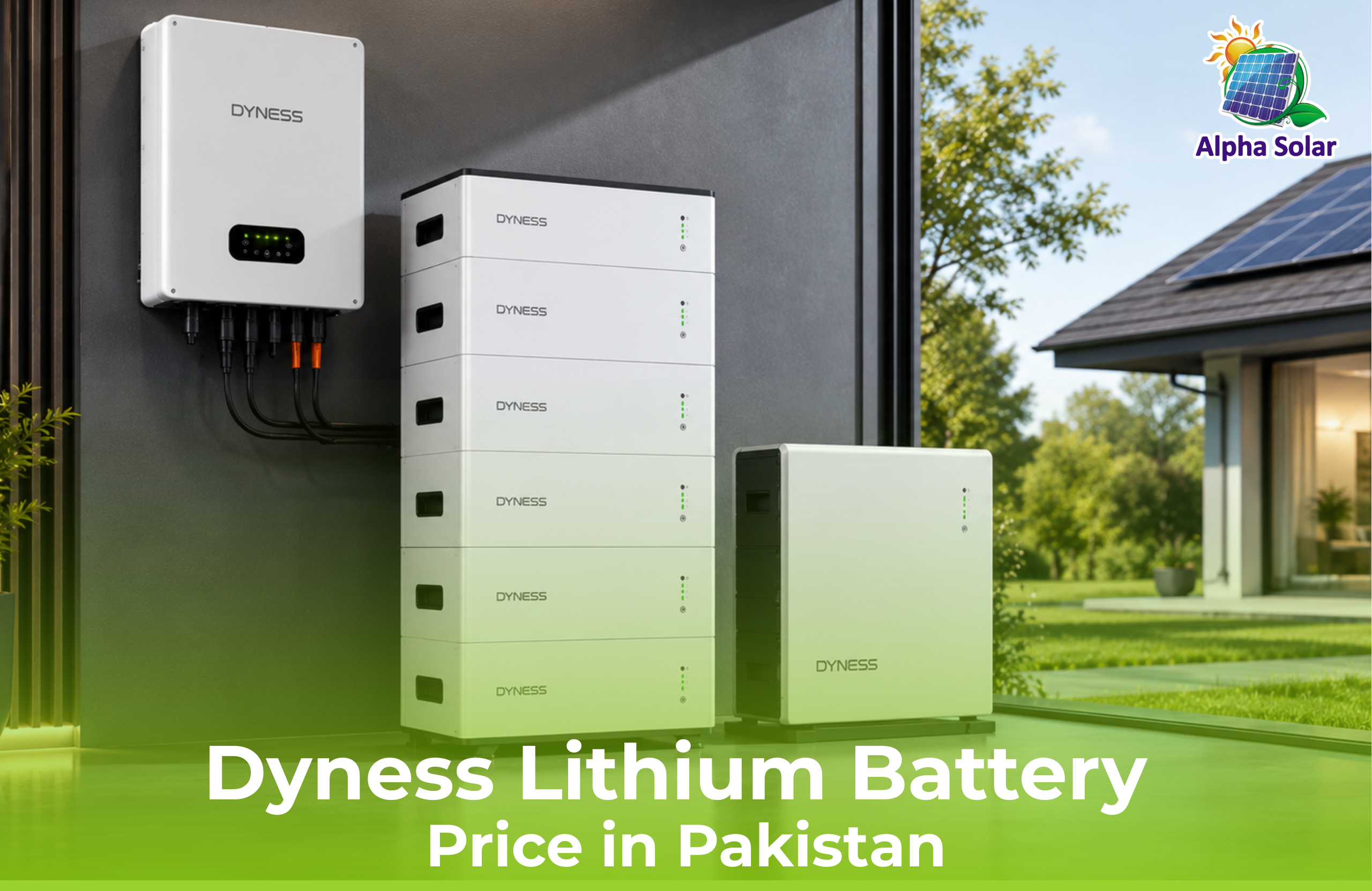
Load shedding doesn’t care what time your meeting starts. It doesn’t care that your kids have an exam tomorrow or that you’re running a generator-dependent shop in a market that closes at 9 PM. Most Pakistani households have already accepted this as a fact of life and moved past it, straight into the one question that actually matters: which battery do I buy so this stops being a problem?
If you’ve spent any time on solar Facebook groups or WhatsApp dealer chats, you’ve probably seen the name Dyness come up again and again. It’s not the cheapest name on the list, and it’s not the most expensive either. It sits in that comfortable middle zone where people who’ve actually used it tend to say good things, and that’s usually a better signal than any spec sheet.
This guide breaks down what a Dyness lithium battery actually costs in Pakistan right now, why the price moves around as much as it does, and how it stacks up against the dozen other lithium battery prices in Pakistan options you’ll see thrown at you the moment you walk into a solar shop.
What is the Dyness Lithium Battery Price in Pakistan
A Dyness lithium battery in Pakistan typically falls somewhere between PKR 130,000 and PKR 700,000. That’s a wide gap, and it should be, because a small 2.5 kWh unit for a basic home setup has almost nothing in common with a stacked 16 kWh system feeding a small business through the night.
For most homes running a 5kW or 6kW hybrid inverter, the number that actually matters is the 5.12kWh model, the DL5.0C. That’s the one almost every installer in Lahore, Karachi, or Islamabad will point you toward first, and it usually lands between PKR 250,000 and PKR 265,000 depending on who’s selling it and what’s happening with the dollar rate that week.
- Dyness AR1.2 (12.8V, small backup unit): around PKR 63,000
- Dyness DL2.5 (2.56kWh, entry-level): around PKR 125,000 to 135,000
- Dyness DL5.0C / BX51100 (5.12kWh, the popular one): around PKR 225,000 to 265,000
- Dyness Powerbox G2 (10.24kWh, for heavier homes): around PKR 545,000
- Dyness PowerBrick / Stack series (14kWh to 16kWh, commercial-leaning): PKR 580,000 to 700,000
If you’re trying to run one AC through the night without panicking every time the compressor kicks in, the 5.12kWh tier is where almost everyone ends up. Anything smaller and you’re really just backing up fans, lights, and the WiFi router, which, fair enough, some households genuinely just want that and nothing more.
Factors that can affect the Dyness Solar Battery price in Pakistan:
This is the part that frustrates people the most, and honestly, it frustrates installers too. You ask one dealer and get one number, you ask another and get something PKR 20,000 apart, and you start wondering if someone’s trying to fool you. Usually, nobody is. A few real reasons this happens:
The dollar decides more than you’d think.
Dyness batteries come into Pakistan as imports. Every rupee the dollar moves, the landed cost moves with it, and dealers adjust their price lists accordingly, sometimes on a weekly basis.
Not every “Dyness” battery is the same battery.
The brand name covers a wide range, from a compact 2.5kWh wall unit to an industrial-scale stacked tower. Someone telling you “Dyness costs 130,000” and someone else saying “Dyness costs 600,000” might both be telling the truth about two completely different products.
Genuine warranty costs more, and it should.
A battery sold by an authorized Dyness distributor with a proper factory warranty will almost always cost more than one floating around without clear paperwork. That gap isn’t a rip-off; it’s the price of not getting stuck with a dead battery and nobody to call.
Where you’re buying it from matters.
A dealer in a smaller city with less stock turnover might price differently than a high-volume seller in Lahore or Karachi. Bulk buyers and installers doing whole housing societies often get a noticeably better per-unit rate than someone buying a single battery for one home.
Why Choose Dyness Solar Battery?
Pakistan’s solar market is genuinely crowded right now. Pylontech, Narada, Knox, Inverex, Soluna, Sofar, BYD, the list keeps growing every year. So why does Dyness keep showing up as a recommended option across installer websites and not just one or two?
A few things tend to come up in actual user reviews and installer feedback, not just marketing pages:
It uses proper LiFePO4 chemistry, the same lithium iron phosphate cells that are considered the safety standard for solar storage. These don’t carry the overheating risk that older lithium-ion types do, which matters a lot in a country where summer roof temperatures aren’t exactly gentle.
The depth of discharge is high, typically in the 90-95% range. In plain terms, a 5.12kWh battery actually gives you close to 5.12kWh of usable power, not the roughly half you’d get from an old-style lead-acid tubular battery of the same size. That difference alone changes how many appliances you can realistically run.
Cycle life sits comfortably in the 4,000-6,000+ range. If you’re charging and draining it daily through solar, that’s a battery that’s still working well a decade from now, not three years from now.
It plays nicely with the inverters Pakistani households are already buying. Growatt, GoodWe and Solis inverter price in Pakistan; these are common pairings, and compatibility issues are rare compared to some of the lesser-known battery brands that occasionally fight with certain inverter brands over communication protocols.
What This Looks Like Against the Wider Lithium Battery Price in Pakistan Picture
Stepping back from Dyness specifically, here’s roughly where the broader lithium battery price in Pakistan market sits in 2026 for the most common home size, the 48V or 51.2V 100Ah battery, which is the same as saying 5kWh or 5.12kWh:
| Brand | Approx. Price (5kWh / 5.12kWh)Approx. Price (5kWh / 5.12kWh) |
|---|---|
| Knox | PKR 215,000 – 250,000 |
| Dyness | PKR 225,000 – 265,000 |
| Narada | PKR 223,000 – 238,000 |
| Pylontech | PKR 280,000 – 310,000 |
| Inverex | Higher, varies by model |
Dyness sits right in the middle of this pack, which is exactly where most installers seem to place it when a customer asks for something reliable without paying Pylontech-level pricing.
A Quick Way to Figure Out What Size You Actually Need
Before you fixate on a price tag, work backwards from your load instead. It’s a five-minute exercise, and it saves you from either overspending or buying something that quits on you at 1 AM.
List what you want backed up at night. Fans, lights, and a router are light work. Add a fridge and a TV, and it’s still manageable. Add even one 1-ton AC running through the night, and your math changes completely.
A single 5.12kWh battery can usually run a 1-ton AC for somewhere around 5 to 7 hours at a comfortable room temperature, alongside the usual fans and lights. If you want that AC running all night, you’re looking at two batteries, or one 10kWh unit, not one 5kWh battery stretched further than it should go.
Check your inverter’s voltage before anything else. A 48V inverter needs a 48V battery; a 51.2V system needs to match that. Buying a battery that doesn’t match your inverter’s voltage is one of the most common and most avoidable mistakes people make when they shop on price alone.
Is It Worth Paying More for Dyness Over a Cheaper Unannounced Brand?
This is really the question hiding underneath all of this. And the honest answer is: it depends on what you’re optimizing for.
If you’re buying a battery for a rental property you’re selling in two years, sure, the cheapest option that technically works might make financial sense. But if this is the battery running your own home, the one your family depends on through long summer nights and the one you’re hoping lasts close to a decade without drama, the gap between a known brand with real warranty support and an unbranded import starts to matter a lot more than the PKR 20,000 or 30,000 you might save upfront.
A battery failing at month 14 with no warranty to fall back on costs you far more than the difference would have.
Reach out to Alpha Solar and let’s figure out the right setup for your home, not just the cheapest one on paper.
Stop guessing. Start storing.
Tell us your inverter and your night load, and we’ll tell you the exact Dyness battery size that fits—no upsell, no guesswork. Get your free Alpha Solar consultation today.
Contact: 0343-3813810
Email: sales@alphasolar.com.pk
Frequently Asked Questions (FAQs)
Is Dyness a good battery for Pakistani weather?
Yes. Dyness uses LiFePO4 cells, which handle high heat far better than older lithium types and don’t carry the same fire risk. That’s a big deal during Pakistani summers when rooftop equipment can sit well above 50°C for hours.
Can a Dyness battery run my AC all night?
A single 5.12kWh Dyness battery can usually run a 1-ton AC for about 5 to 7 hours. For a full night of AC backup, you’ll want two batteries or a 10kWh unit instead of stretching one battery further than it’s built for.
Is Dyness compatible with my existing inverter?
In most cases, yes. Dyness batteries work well with common inverter brands like Growatt, GoodWe, and Solis. Just confirm your inverter’s voltage (48V or 51.2V) matches the battery before you buy, since that’s the most common mismatch people run into.
Related Informational Links:
Solar Panel Price in Pakistan
Solar System Price in Pakistan
Solar Battery Price in Pakistan: A Complete Guide by Alpha Solar
Top 10 Solar Companies Near Me in Pakistan (2026)
Speak to an Expert
To get your solar system installation by the top experts at the best rates, call the number below or visit our office for a free consultation and site survey
Contact: 0343-3813810
Email: sales@alphasolar.com.pk

Leave A Comment