
Almost nobody compares mounting structures. Buyers compare panel brands, argue about inverter models, research battery chemistry, then accept whatever steel the installer puts underneath. It is the one component quoted as a single word.
That stopped being a small omission in May 2025. After the windstorms across Punjab, the Provincial Disaster Management Authority attributed most of the damage not to panels but to the structures holding them. Alphasolar has specified structures against wind loading from the start, and this is what that involves.
Key Takeaways
What failed in the May 2025 storms? The structures, not the panels. PDMA linked the damage to arrays lifting off roofs.
What wind speed should it handle? The Building Code of Pakistan uses basic wind velocity zones of 120 and 130 km/h.
Which galvanising should you insist on? Hot dip, at 55 to 100 microns, rather than pre galvanised sheet at 10 to 30.
How much load does an array add? Roughly 15 to 25 kg per square metre rail mounted, and far more if ballasted.
Why Did Solar Panels Cause So Much Storm Damage in 2025?
Because the arrays came off the roofs, and once airborne a panel is a rigid sheet travelling at wind speed.
After the Punjab windstorms of late May 2025, the Director General of PDMA Punjab stated that around 80 percent of the damage across the province came from uprooted solar panels, and that roughly 70 percent of the human losses were linked to failures of solar panel structures. More than 110 people were injured. Those are official statements rather than a published engineering investigation, so treat the exact split as an attribution. The direction is not in dispute.
Set that against the scale. Pakistan imported around 17 gigawatts of solar equipment by the end of 2024, more than any other country, and much of it went onto rooftops fast, with the structure the easiest place to save money.
What Wind Speed Should a Structure in Pakistan Be Designed For?
The Building Code of Pakistan, through BCP SP:07, works from basic wind velocity zones of 120 and 130 km/h depending on location.
Two things follow. A structure designed with no reference to any wind figure is not engineered, it is assembled. And a basic design velocity is not the gust your roof will meet, because exposure, building height, parapet geometry and panel position all change the real pressure. Corner and edge panels carry far more load than those in the middle, which is why arrays peel from a corner. Alphasolar designs to the code basis, then treats edge zones separately.
Is the Wind Pushing Down or Lifting Up?
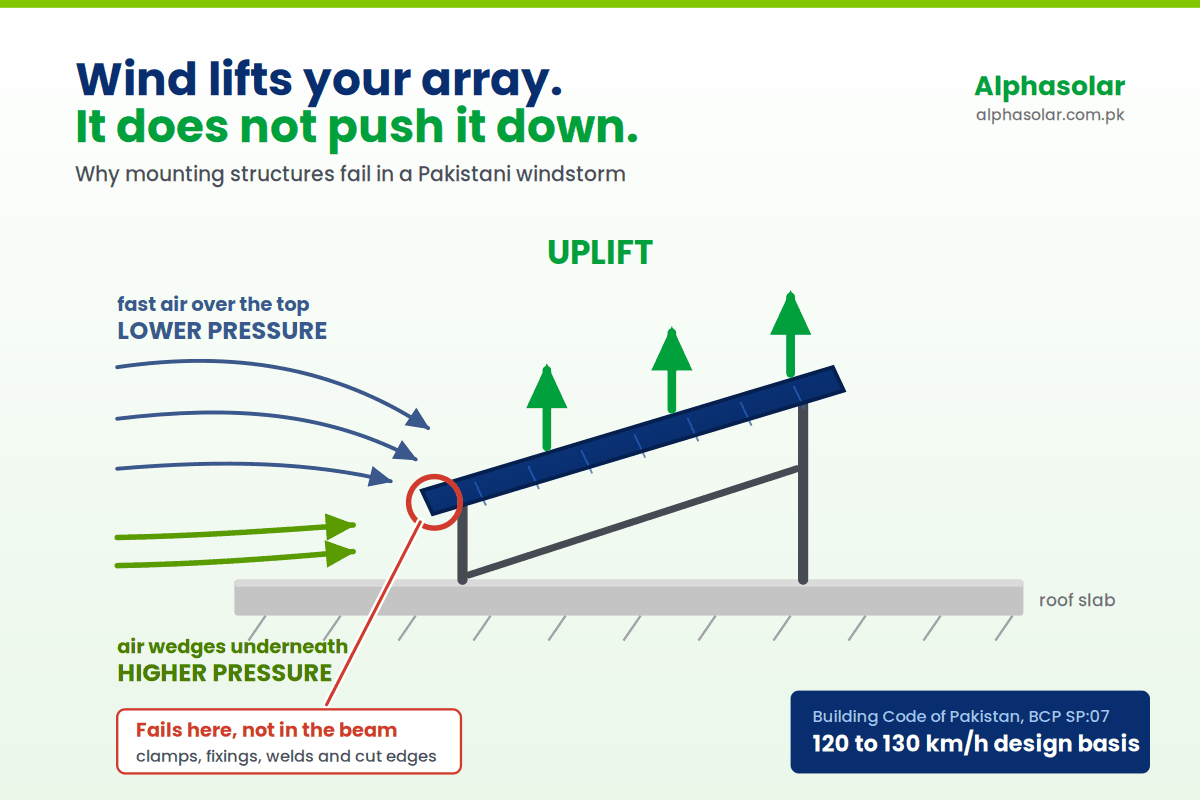
Lifting up, and it is the most misunderstood point in rooftop solar.
A tilted panel in moving air behaves like a wing. Pressure drops above it while air wedging underneath raises pressure below, and the net force rotates it upward off its mounts. That is why heavier panels do not make an array safer, and why fixings matter more than beams.
It also explains the failure pattern. Panels do not snap in half. They tear out of their clamps, or the structure tears out of the roof. Our guide to solar fire safety in Pakistan covers the other category of install defect that stays invisible until it matters.
What Should the Steel Actually Be?
Hot dip galvanised, in almost every Pakistani installation. The coating decides whether it is sound in fifteen years.
| Coating | Typical thickness | Standard | Indicative life inland | Coastal |
|---|---|---|---|---|
| Hot dip galvanised | 55 to 100 microns | ISO 1461, ASTM A123 | Several decades | Around 28 years |
| Pre galvanised sheet | 10 to 30 microns | ASTM A653 | Roughly 13 years | Around 6 years |
| Zinc aluminium magnesium | 20 to 40 microns | EN 10346, JIS G 3323 | Around 19 years | Comparable to hot dip |
| Painted mild steel | Paint only | None applicable | Rust within a few seasons | Worse |
Hot dip galvanising on sections of 6 mm and above runs to a mean of about 85 microns, and 70 on thinner sections. Pre galvanised sheet is around 19 microns per face at G90. That is not a small difference in a number, it is a different product life. Alphasolar quotes the coating rather than calling the steel galvanised and stopping there.
Painted angle iron deserves a warning. It is cheap, common on Pakistani rooftops, and in the monsoon it fails at the fixings, where strength is least negotiable.
Why Do Structures Fail at the Welds?
Because welding destroys the coating exactly where stress concentrates.
Hot dip galvanising protects bare steel only about one to two millimetres beyond a cut edge. Past that it corrodes at the normal atmospheric rate. Field welding a pre galvanised section is worse, because the heat affected zone loses its coating entirely, leaving bare steel at every joint. Where welding is unavoidable the remedy is a zinc rich repair coat at roughly 100 microns, per ASTM A780.
Better to avoid field welding. Bolted connections keep the factory coating intact, can be inspected and retorqued. Alphasolar favours bolted assemblies, and treats any cut surface as a coating repair rather than an afterthought.
Can Your Roof Carry the Load?
Usually yes, and the weight is less than most people fear.
A single panel runs roughly 22 to 35 kg, a 470 watt module near 22 and a 650 watt module close to 35. Across the array footprint panels alone come to about 11 to 13 kg per square metre, and a rail mounted system near 15 to 25 once rails, clamps and fixings are counted.
Ballasted systems, which hold the array down with weight instead of fixings, are a different proposition. They typically add 30 to 60 kg per square metre, and an exposed or high tilt layout can reach 75 to 100, because ballast is set by the uplift calculation. On a questionable slab that is the decision point, which is why Alphasolar does not treat ballast as the easy no drilling option.
Roofs that need a check are older houses, roofs already extended once, slabs with cracking or water damage, anything elevated to clear a parapet or water tank, and steel sheet roofs. Elevated structures are the quiet risk, because height increases the lever arm on every fixing. Alphasolar routes larger sites through solar system design and consultancy first, when a structural problem is still cheap, as it does for commercial solar solutions and industrial solar solutions.
What Is PDMA Asking Installers to Do Now?
Asking, rather than requiring, and the distinction matters.
After the 2025 storms PDMA called for installations to be weather resistant and technically sound, built with certified materials following established engineering standards, structurally secure and approved by the relevant officials. It also asked for surveys of dangerous structures and inspection of existing ones. None of that is yet binding, so do not assume an inspector will catch a weak structure for you.
It does show where regulation is heading. Alphasolar builds to that standard now, and our solar services page sets out what is included.
What Should a Structure Quote Show?
If the structure is one line with no specification, ask for these seven items before comparing totals.
- Steel section sizes and the grade used
- Coating type and thickness in microns, not the word galvanised
- The wind velocity the design was checked against
- How it fixes to the roof, and how those penetrations are waterproofed
- Whether connections are bolted or welded, and how cut surfaces are recoated
- Tilt angle, row spacing and height above the roof surface
- Who takes responsibility for the structural design
A cheaper quote almost always differs on items two, three and four. Those are the invisible ones, which is why they get cut. Alphasolar itemises the structure the way it itemises panels. See configurations on solar packages, or spread the cost through easy installments and solar financing.
Where Does Structure Failure Hit Hardest in Pakistan?
The Punjab plains, by a wide margin, because pre monsoon dust storms arrive with little warning and rooftop density is highest. Lahore, Sialkot and Jhelum all took casualties in May 2025. Islamabad and Rawalpindi face a second problem, since the April 2025 hailstorm damaged vehicles and panels across the city, and hail loads the glass rather than the frame. Alphasolar treats the two exposures as separate design questions.
Karachi and the coastal belt trade wind for corrosion. Salt laden air puts a rooftop into a far more aggressive category, where the gap between hot dip and pre galvanised steel becomes a replacement in six years. Interior Sindh, southern Punjab and the Balochistan plateau combine sustained wind with abrasive dust, which is why Alphasolar quotes agriculture solar solutions and village solar solutions differently from an urban rooftop. Alphasolar work across these regions is on our projects page.
Quick Answers on Solar Mounting Structures in Pakistan
- The Building Code of Pakistan works from 120 and 130 km/h wind velocity zones, so a design with no stated wind figure is not engineered.
- Wind lifts an array rather than pressing it down, which is why clamps and fixings decide survival, not panel weight.
- Hot dip galvanising at 55 to 100 microns outlasts pre galvanised sheet at 10 to 30, and the gap widens near the coast.
- A rail mounted array adds roughly 15 to 25 kg per square metre, while ballasted layouts can reach 75 to 100.
- Alphasolar states coating thickness, wind basis and fixing detail on the quote, so the structure can be compared, not assumed.
People Also Ask
Can strong wind really lift solar panels off a roof? Yes. A tilted panel generates upward force in moving air, and arrays fail by tearing out of clamps or fixings rather than breaking.
Is hot dip galvanised structure worth it in Pakistan? In almost every case. The coating is several times thicker than pre galvanised sheet, and inland it lasts decades rather than a dozen years.
Do I need permission for the mounting structure itself? No binding national standard currently requires structural approval for rooftop solar, though PDMA has recommended inspection and official sign off after the 2025 storms.
Will solar panels damage my roof waterproofing? Only if the penetrations are done badly. Each fixing point needs sealing, and how that is handled should be written into your quote.
FAQs
How do I know if my existing structure is safe? Look for rust at fixings and welds, loose or missing clamps, and movement when you push a panel at its corner. Alphasolar can inspect an array and report what it finds. Routine checks are in our guide to solar panel cleaning and maintenance.
Does replacing my structure affect net billing? It should not, since a structure swap does not change generation capacity. Changing capacity is different, and our guide to net metering and net billing explains what puts a registration at risk.
Ready to See the Structure on Your Quote?
Send Alphasolar a rooftop photo, your location and the system size you want, and Alphasolar will specify the structure in writing, with the coating, wind basis and fixing method stated. That is the part of a quote nobody shows you, and the part that decides what is still on your roof after the next storm. Start at get a quote, or read more on about us.

Leave A Comment