
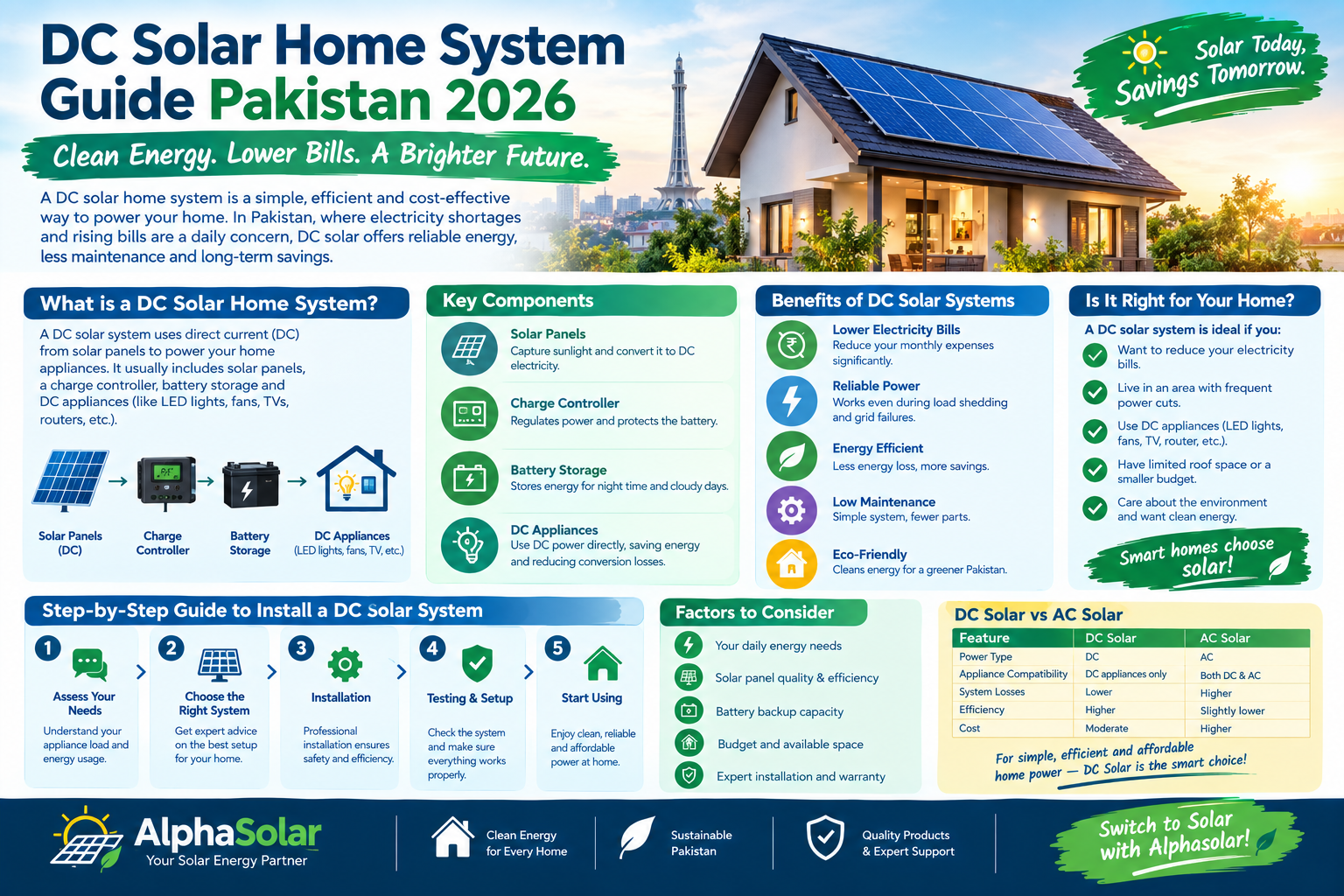
A DC home system has no inverter. Panels charge a battery through a controller, and your appliances run straight off that battery on direct current. Nothing converts anything. For fans, lights and charging, that simplicity delivers more usable hours from a smaller system than the same money spent on a conventional setup. Alphasolar recommends it for a narrow set of situations and says plainly when it is the wrong answer.
The narrowness matters. These systems are excellent inside their limits and frustrating the moment you push past them.
Key Takeaways
What is in the system? Panels, a charge controller, a battery and DC appliances. No inverter anywhere.
Why does that help? Every conversion loses energy, and removing the inverter removes the largest loss.
What will it run? DC fans, LED lighting, phone and device charging, small DC pumps.
What will it not run? Air conditioning, irons, washing machines, most refrigerators and anything with an AC motor.
What is the brain? The charge controller, where the choice between PWM and MPPT actually matters.
When should you skip it? As soon as your list includes a normal household appliance.
Why Does Removing the Inverter Change So Much?
Because every conversion between direct and alternating current costs energy, and Alphasolar finds that at small scale it is a large share of what you generated.
A conventional system stores direct current in a battery, converts it to alternating current through an inverter, then feeds appliances that often rectify it back to direct current internally. Your phone charger, your LED driver and your brushless fan motor all want direct current in the end. The round trip is wasteful, and the inverter also draws a standby current simply for being switched on.
A DC home system removes that entire stage. The battery feeds the appliance directly, so what you stored is very close to what you use. There is no standby drain when nothing is running, no inverter to fail, and no conversion loss to size around.
Alphasolar builds these under DC home systems, and the simplicity is the product rather than a compromise.
What Can a DC Home System Actually Run?
Less than people hope and more than people expect, which is why Alphasolar starts with the honest list.
| Appliance | Runs on DC? | Notes |
|---|---|---|
| Ceiling and bracket fans | Yes | Brushless DC motors draw far less than AC fans |
| LED lighting | Yes | Natively direct current already |
| Phone and device charging | Yes | Many controllers include USB outlets |
| Small television | Yes | DC models widely available |
| Small DC water pump | Yes | Within modest head and flow limits |
| Refrigerator | Only DC models | Standard AC fridges will not run |
| Washing machine and iron | No | AC motors and heating elements |
| Air conditioning | No | Far beyond what this architecture carries |
Brushless DC fans are the reason these systems work so well in Pakistan. They draw considerably less than conventional fans, so a modest battery delivers a long evening of air movement during load shedding. Alphasolar finds that single appliance carries most of the value for most households.
Is a PWM or MPPT Controller Worth the Difference?
Alphasolar treats this as the one component decision that genuinely changes output, and it is where a DC system quietly succeeds or disappoints.
A pulse width modulation controller connects panel to battery and effectively pulls the panel down to battery voltage. It is simple, cheap and reliable, and it wastes the difference between the panel’s optimum operating voltage and the battery’s actual voltage.
A maximum power point tracking controller converts instead of connecting. It holds the panel at its most productive operating point and converts the surplus voltage into additional charging current. The gain is real, and it is largest exactly when you need it most, in weak winter light, in early morning and late afternoon, and under cloud.
So the sensible rule is scale. On a very small single panel setup for lights and a fan, a simple controller is proportionate. Once the array grows, or your winter performance matters, tracking earns its cost. Alphasolar sizes the controller against the array rather than selling the more expensive option by default. Browse the solar charge controller range.
Where Do DC Systems Genuinely Win?
Four situations, and outside them Alphasolar will tell you a conventional system is the better purchase.
- Homes with no grid connection at all, where every unit must be self generated
- Very small budgets, where a DC kit is achievable and a full system is not
- Single room needs, such as lighting and a fan for a bedroom or shop counter
- Temporary or mobile sites, including construction huts, stalls and farm structures
Pakistan has a great deal of all four. Villages awaiting connection, tenants unwilling to install fixed equipment, small shops needing counter lighting through load shedding, and farm outbuildings far from any supply. Alphasolar covers these under village solar solutions and agriculture solar solutions.
What unites them is a short, honest appliance list. When the list stays short, a DC system is the most efficient rupee you can spend on solar.
When Should You Stop and Buy a Proper System Instead?
The moment your list includes a normal household appliance, and Alphasolar would rather say that early than sell you something you will outgrow.
People arrive wanting a DC system and then mention the fridge. Or the washing machine. Or that the summer really needs an air conditioner. At that point the architecture is wrong, and bolting an inverter onto a DC setup produces a worse and more expensive version of a system that should have been designed conventionally from the start.
There is no clean upgrade path either. A DC home system is not a small hybrid system waiting to grow. The appliances themselves are different hardware, so scaling up usually means replacing the fans and lights you bought, not just adding panels.
If your list is heading that way, start with a 3kW solar system or look at domestic solar solutions, with easy installments and solar financing where the barrier is timing rather than total cost.
What Goes Wrong With Cheap DC Kits?
Three things, and Alphasolar finds all of them avoidable at purchase.
Undersized cabling is the most common fault Alphasolar is called out to. Low voltage means high current for the same power, so cable that looks adequate runs warm and drops voltage badly enough that lights dim and fans slow at the far end of the run. Alphasolar sizes cable to the actual current and run length rather than to the appliance rating.
Battery choice is the second. Small sealed batteries bundled into cheap kits are frequently undersized and poorly matched to daily cycling, which is why a kit that impressed in month one disappoints by month eight. Compare solar dry batteries against lithium options before accepting whatever came in the box.
The third is a controller with no protection worth the name. Over charge, over discharge and reverse polarity protection are what keep the battery alive, and the cheapest units skimp on exactly that. Alphasolar specifies the controller separately rather than accepting a bundled unknown.
Where Are DC Home Systems Used Across Pakistan?
Wherever the grid is absent, unreliable or too expensive to connect to, which is most of the territory Alphasolar covers off grid.
Interior Sindh and southern Punjab carry the largest share, across villages and farm settlements where connection remains incomplete or supply runs for only part of the day. Balochistan’s dispersed settlements are the clearest case of all, since distance from any feed makes a small self contained system the only practical answer. Across rural Khyber Pakhtunkhwa, hill settlements and seasonal structures use them for lighting and charging rather than comfort. In cities, the pattern changes entirely, with small shops, roadside stalls, market counters and tenants in Lahore, Karachi and Rawalpindi buying compact kits to keep lights, fans and payment devices running through load shedding. Alphasolar supplies across all of these, and completed work sits on our projects page.
Quick Answers on DC Home Systems in Pakistan
- A DC home system has no inverter, so the battery feeds appliances directly with no conversion loss and no standby drain.
- Brushless DC fans carry most of the value, drawing far less than conventional fans and delivering long backup on a modest battery.
- It will not run air conditioning, irons or washing machines, and standard refrigerators need a DC model instead.
- The charge controller is the decisive component, with tracking controllers earning their cost as the array grows.
- There is no clean upgrade path, since scaling up means replacing DC appliances rather than simply adding panels.
- Alphasolar agrees the appliance list first, and will recommend a conventional system where the list is heading beyond DC limits.
- Cheap bundled kits fail on cable, battery and controller protection, so Alphasolar specifies each of the three separately rather than accepting a sealed box.
People Also Ask
What is a DC solar home system? A small off grid setup where panels charge a battery through a controller and appliances run directly on direct current. There is no inverter, so nothing converts between current types.
Can a DC solar system run a refrigerator in Pakistan? Only a purpose built DC refrigerator. A standard fridge uses an AC compressor and will not run without an inverter, at which point a conventional system is the better design.
Is MPPT better than PWM for a small DC system? It harvests more, particularly in weak light and winter. On a very small single panel setup the simpler controller is proportionate, while larger arrays justify tracking.
Can I add an inverter to a DC home system later? Technically possible and rarely sensible. The result is more expensive and less capable than a conventional system designed properly from the start.
FAQs
Do DC fans really use less power than normal fans? Yes. Brushless direct current motors are substantially more efficient than conventional fan motors, which is why a modest battery runs several of them through a long evening outage.
Is a DC system suitable for a rented property? Often, since it needs no fixed rooftop array or grid connection work. Tenants and stallholders use them precisely because the equipment moves when they do. See the wider solar products range.
Send Us Your Appliance List First
Write down exactly what you want running and for how long each evening. That list, not a budget figure, tells Alphasolar whether a DC home system fits you or whether you should be looking at a conventional setup. Start at get a quote, or browse solar panels for the array side.
Leave A Comment