
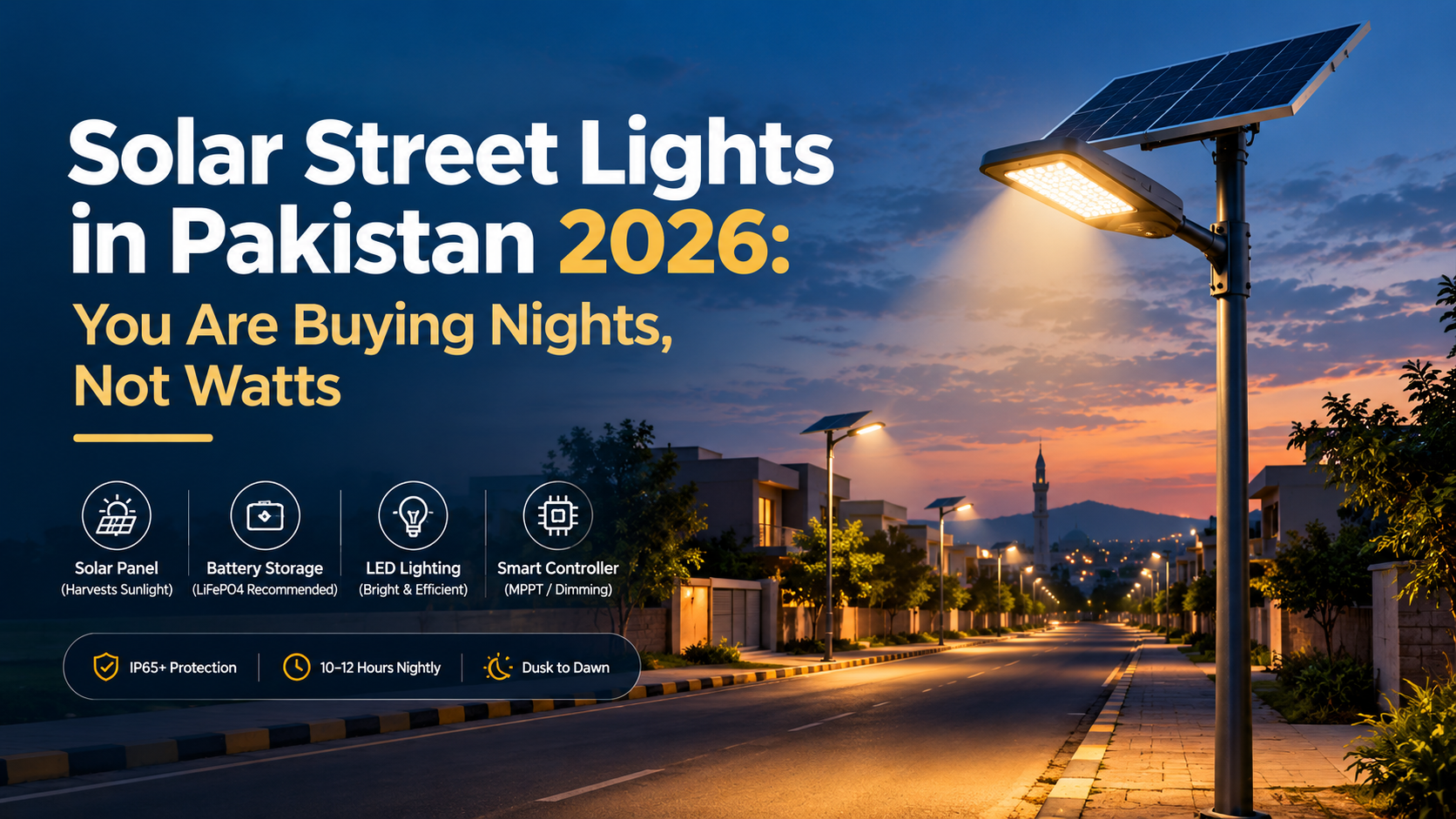
Almost every solar street light quote in Pakistan leads with watts, the least useful number on the page. What decides whether a light still works on the fourth overcast night of a monsoon week is autonomy. What decides whether it works in year five is the temperature inside the battery compartment. Alphasolar quotes both.
Housing societies and factory owners discover this the same way. The lights perform beautifully for a season, then a cloudy stretch arrives and half the street goes dark by 2am.
Key Takeaways
What number actually matters? Autonomy days, meaning how many sunless nights the system keeps running.
Why do lights fail early? Sizing against average sunshine instead of your worst month.
All in one or split? All in one for streets and societies, split for high output and extreme heat.
What kills the battery? Heat inside a sealed pole head, which is severe in a Pakistani summer.
Which chemistry suits here? Lithium iron phosphate, which tolerates heat far better than the alternatives.
Does brightness alone fix dark patches? No. Pole height, spacing and optic distribution decide coverage.
Why Is Wattage the Wrong Thing to Compare?
Because it describes the fixture rather than the outcome, and two lights rated identically can light a road completely differently.
Coverage comes from lumen output, optic distribution, mounting height and pole spacing together. A high wattage head with the wrong distribution throws light where nobody walks and leaves darkness between poles. What you want specified is lux at ground level across the road width.
Alphasolar sizes in the opposite direction from how quotes are written. Start from the load, not the panel. Work out the nightly energy the luminaire consumes in watt hours across each segment of its operating profile, since a controller that dims after midnight draws differently before and after. Only then size battery and panel to cover it. See our solar street lights range.
What Are Autonomy Days, and Why Do Installations Fail Without Them?
Autonomy is how many consecutive sunless nights the system runs before the battery is exhausted. Alphasolar treats it as the decisive specification, and it is routinely absent from quotes.
Systems fail for one of two reasons. They were sized against annual average sunshine rather than the worst month, or the autonomy target was too low for the site’s cloud patterns. Both look fine in April and fail in July.
Pakistan makes this concrete. Monsoon brings multi day overcast stretches across Punjab and Sindh, and winter fog cuts charging while nights run longest. Those two seasons are the design case.
Ask any supplier two questions. Which month’s sun hours was this sized against, and how many autonomy days does the configuration deliver at this location. Alphasolar states both in writing.
All in One or Split: Which Suits Your Site?
It depends on output, heat and how exposed the site is.
An all in one unit houses the panel, battery, controller and LED in a single fixture. It installs fast, needs no trenching and presents very little to steal, since removing it means unbolting the whole assembly in plain view. A split system mounts the components separately and cables them together, which lets the panel be oversized and tilted independently and keeps the battery out of the hot fixture housing.
| Consideration | All in one | Split |
|---|---|---|
| Installation speed | Fast, single bracket | Slower, more components |
| Panel tilt and oversizing | Fixed by the housing | Adjustable and scalable |
| Battery temperature | Shares the hot fixture | Separated, runs cooler |
| Theft exposure | Low, nothing loose to take | Higher, cables and panel accessible |
| Best for | Streets, societies, parking, paths | High output, yards, highways, extreme heat |
| Maintenance | Whole unit serviced | Components serviced individually |
The dividing line is output and heat. Below moderate wattages on an accessible site with clear sky, all in one is usually right. Above that, or where summer temperatures are punishing, a split system’s thermal separation earns its cost. Alphasolar specifies both, and larger sites sit under commercial solar solutions and industrial solar solutions.
What Question Exposes a Weak Supplier?
Ask for the battery compartment temperature under load at forty five degrees ambient.
In an all in one fixture the battery shares a sealed housing with the LED board and driver, on a pole in full sun. Lithium cycle life is strongly temperature dependent, so that figure decides whether you replace batteries in year seven or year three. A supplier who has measured it will tell you. One who has not will change the subject.
Chemistry matters alongside placement. Lithium iron phosphate holds up far better in sustained heat and survives many more cycles than ternary lithium, which degrades quickly as ambient climbs. Lead acid gives only about half its rating in usable depth, a poor fit for nightly cycling.
Housing is the third factor. Die cast aluminium pulls heat away from the driver far better than lighter alternatives, protecting electronics as well as battery. Alphasolar checks all three, and our lithium battery price in Pakistan page covers the chemistry in more depth.
How Do Pole Height and Spacing Decide Coverage?
Together, and Alphasolar finds getting them wrong produces dark patches no extra brightness will fill.
Three measurements drive the layout. Road width sets how far light must spread. Mounting height determines how wide each pool of light reaches. Pole spacing decides whether those pools overlap or leave gaps.
The specification tying them together is optic distribution, published as a photometric file. Distribution type matters as much as lumen output, since a fixture throwing light along a road behaves nothing like one flooding an open area. Ask for the file rather than accepting a brightness claim.
Alphasolar works from measured site geometry rather than a standard pole interval, which is what separates a lit street from a street with lights on it. Rural and off grid work sits under village solar solutions.
How Serious Is Theft, and What Reduces It?
Serious enough that Alphasolar treats it as a design input, particularly on rural roads and unguarded perimeters.
Integrated units are harder targets. No exposed cable runs to strip, no separately mounted panel to lift, so taking one means unbolting the whole fixture with tools, in the open, over several minutes. Split systems present both a panel and accessible cabling, the two things most commonly taken.
Where a site demands split architecture for thermal or output reasons, the mitigation is physical. Anti theft fixings, concealed cable routing, cages on ground mounted panels and lighting placed where it is overlooked rather than isolated. Alphasolar raises this at survey, because a specification chosen purely on performance can be the wrong specification for an exposed location.
Can Dimming Extend Autonomy?
Substantially, and Alphasolar rates it the cheapest way to buy extra nights of reserve.
Quality controllers support a programmable profile, running full output through busy evening hours and stepping down when traffic falls away. Motion sensing goes further, holding a lower baseline and lifting when someone approaches. Both cut nightly consumption, so the same battery covers more sunless nights.
Two cautions. Dimming should stay above a sensible minimum rather than dropping to a level that defeats the point. And controller type matters, since maximum power point tracking harvests noticeably more in weak winter light. Our solar charge controller page covers that difference.
When Do Solar Street Lights Not Make Sense?
When mains power already sits at the pole base, which is worth saying plainly.
Solar lighting wins hardest where connecting to the grid means trenching and cable runs across ground you do not want dug. Approach roads, farm tracks, society peripheries, parking areas away from supply and factory perimeters all fit. The installation saving alone can outweigh the fixture premium.
Where a feed is already present and a conventional fixture can be wired in, the case is narrower, resting on running cost and outage resilience rather than installation economics. Alphasolar says so rather than selling solar into a situation that does not need it. Related work sits under gas station solar solutions and domestic solar solutions.
Where Are Solar Street Lights Being Installed Across Pakistan?
Demand concentrates wherever running a cable is harder than mounting a pole.
Housing societies across Lahore, Islamabad and Rawalpindi lead residential demand, lighting peripheral roads and green belts that were never wired. Karachi skews industrial, across Korangi and SITE perimeters, where coastal salt exposure makes corrosion protection a real specification. Faisalabad, Sialkot and Gujranwala factories light yards, loading areas and boundary walls. Across rural Punjab and interior Sindh, village access roads are the clearest case, since no feed exists to connect to. Alphasolar has installed across these conditions, and completed work sits on our projects page, with servicing through solar services.
What Do Alphasolar Customers Say?
Client action needed: replace the bracketed placeholders with four real reviewer names from your Google Business Profile. I have not written fabricated testimonials.
Reviewers on the Alphasolar Google Business Profile mention the same points on lighting projects: autonomy days were stated on the quote, pole spacing came from a site measurement rather than a standard interval, and battery chemistry was specified rather than left vague. [Reviewer 1] mentioned lights holding through a monsoon week. [Reviewer 2] noted anti theft fixings included on an exposed perimeter. [Reviewer 3] and [Reviewer 4] both referenced dimming profiles set to the site’s actual usage hours. Reach the team through contact us, or read more on about us.
Google Business Profile: [INSERT GBP MAP EMBED OR SHARE LINK]
Quick Answers on Solar Street Lights in Pakistan
- Autonomy days is the decisive specification, describing how many consecutive sunless nights the system keeps running.
- Sizing must use your worst month, not annual average sunshine, or the system fails during monsoon and winter fog.
- All in one suits streets and societies, while split architecture suits high output sites and extreme heat.
- Battery temperature decides lifespan, so ask what the compartment reaches under load at forty five degrees ambient.
- Pole height, spacing and optic distribution create coverage, and extra brightness will not fix a spacing error.
- Alphasolar states autonomy days and battery chemistry on the quote, and sets pole spacing from measured site geometry.
People Also Ask
How many hours do solar street lights run at night in Pakistan? A well designed system runs from dusk to dawn, often at reduced output after peak hours. The meaningful question is how many consecutive cloudy nights it sustains that, which is its autonomy.
Do solar street lights work in monsoon and fog? Yes, if sized for it. Systems designed around annual average sunshine rather than the worst month are exactly the ones that fail during extended overcast stretches.
Which battery is best for solar street lights here? Lithium iron phosphate, because it tolerates sustained heat far better than ternary lithium and delivers far more usable capacity per cycle than lead acid.
Are all in one solar street lights better than split systems? Neither is universally better. All in one wins on installation speed and theft resistance, while split systems suit higher output and keep the battery out of a hot fixture housing.
FAQs
What maintenance do solar street lights need? Panel cleaning, which matters more on dusty roads and industrial sites than most buyers expect, plus eventual battery replacement. Everything else is generally sealed and serviceable only as a unit.
Can I add solar street lights gradually? Yes. Because each pole is independent with no cabling between them, a society or factory can light one stretch at a time. Where budget timing is the constraint, easy installments and solar financing apply.
Send Us Road Width and Pole Positions
Those two measurements, plus how many cloudy nights you need the lights to survive, determine the whole specification. Send them to Alphasolar and we will quote autonomy days rather than watts. Start at get a quote, or browse the wider solar products range.

Leave A Comment