
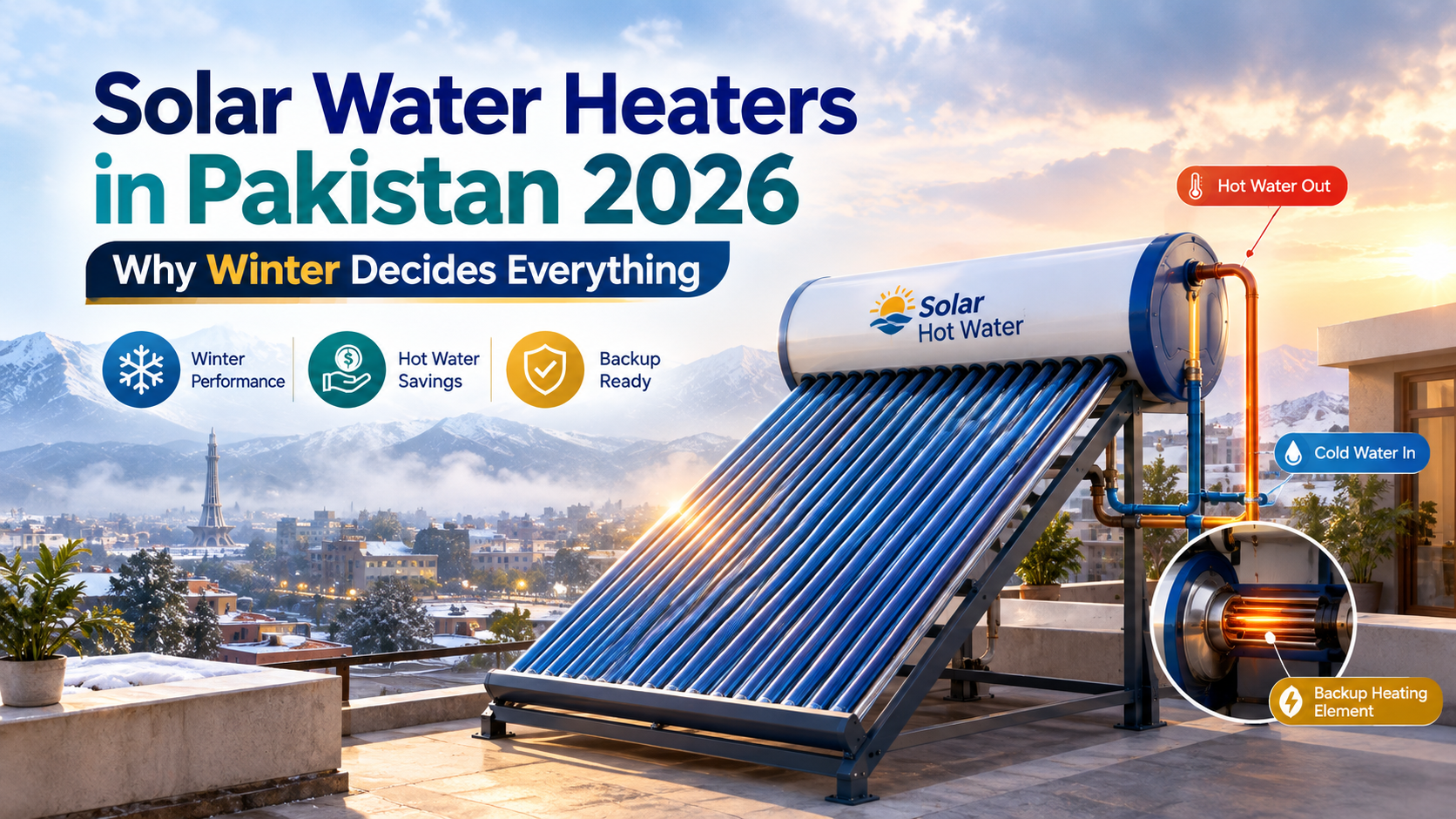
A solar water heater contains no photovoltaic cells, no inverter, no battery and no net metering application. It heats water directly with sunlight rather than making electricity first. That is why it can deliver hot water during a gas outage and a power cut at the same time. Alphasolar treats it as a separate product from a rooftop solar system, because it is one.
The design problem is the season. Demand for hot water peaks in winter, which is exactly when sunlight is weakest and shortest. Everything worth deciding about these systems follows from that tension.
Key Takeaways
Does it need solar panels? No. Thermal collectors absorb heat directly and produce no electricity at all.
Which collector suits Pakistan? Flat plate for consistently sunny areas, evacuated tube where winters are genuinely cold.
What size do you need? Roughly eighty to a hundred litres per day for two people, and around double that for four.
Does it work during load shedding? Yes. With no gas and no electricity, sunlight alone heats the water.
Do you still need a backup? Usually, for extended cloudy spells and heavy winter demand.
What ruins tanks early? Water quality and scaling, which most buyers never ask about.
Why Is a Solar Water Heater Not a Solar Panel?
Because it converts sunlight into heat rather than electricity, and skipping that conversion is the whole point.
A photovoltaic panel turns sunlight into current, which then runs an inverter, which then powers an electric element to heat water. Every one of those steps loses energy. A solar water heater removes them. Sunlight strikes a collector, the collector warms water directly, and an insulated tank stores it. No current is generated anywhere in the system.
Two useful consequences follow. There is no net billing application, no approved equipment list and no sanctioned load question, because you are not connecting anything to the grid. And when gas pressure drops in January and the power goes at the same time, the water in that tank is still hot.
Alphasolar sells both, and they answer different problems. See solar water heaters in Pakistan alongside our solar panels range.
Flat Plate or Evacuated Tube: Which Should You Buy?
Alphasolar decides this on your winter, not your budget.
A flat plate collector is an insulated box with a glass cover and a blackened absorber plate carrying water through riser tubes. It is simple, robust and well proven, and in consistently sunny conditions it performs perfectly well for a lower outlay.
An evacuated tube collector uses double walled glass tubes with a vacuum between the layers. That vacuum is excellent insulation, which is why these units hold their performance in cold, overcast and windy conditions where a flat plate starts losing heat to the air around it.
| Consideration | Flat plate | Evacuated tube |
|---|---|---|
| Cost | Lower | Higher |
| Cold weather performance | Weaker | Considerably stronger |
| Overcast performance | Weaker | Better in diffuse light |
| Roof space for same output | More | Less |
| Repair if damaged | Whole panel affected | Individual tubes replaceable |
| Best suited to | Sunny plains with mild winters | Genuinely cold winters |
Alphasolar recommends flat plate across much of Punjab and Sindh where winters stay mild and sunshine is reliable, and evacuated tube for Khyber Pakhtunkhwa, northern districts and anywhere the January mornings are genuinely cold.
Why Does Winter Break So Many Installations?
Because hot water demand and solar availability move in opposite directions, and Alphasolar sees buyers size for the wrong season.
In June you barely want hot water, and the collector produces more than you can use. In January you want it most, the days are short, the sun sits low, and morning fog across the Punjab plains can flatten output for days at a time. A system that looked generous in summer can leave you cold in the month you bought it for.
Three design responses work:
- Size against winter demand rather than annual average use
- Choose the collector type for your coldest weeks, not your sunniest
- Plan a backup element for extended overcast spells
Alphasolar sizes from winter demand as standard. It is the difference between a system that disappoints once a year and one that does not.
How Big a System Does Your Household Need?
Work from people and habits rather than house size, starting with how many bathe and when.
A rough planning figure is eighty to a hundred litres of hot water per day for two people, and roughly double that for a family of four. Households that bathe in the evening, run a washing machine on hot, or have guests staying will sit above those figures. A house with one bathroom used twice a day sits below them.
Two practical notes. Tank capacity is storage, not production, so a large tank paired with an undersized collector simply holds lukewarm water. And storage is genuinely useful here, because water heated at noon stays hot into the evening, which is why these systems deliver at night without any battery involved.
Alphasolar sizes collector and tank together. Commercial demand is a different calculation entirely, covered under commercial solar solutions and industrial solar solutions for hotels, hostels, clinics and processing units where hot water runs continuously.
What Should You Ask About the Tank?
Construction and water quality, in that order, because Alphasolar finds lifespan is decided here.
Pressurised stainless steel tanks are stronger and longer lived than the alternatives, and they maintain mains pressure at the tap rather than relying on gravity. That matters in apartments and any home where showers need pressure to work properly.
Then ask about your water. Hard water leaves mineral scale inside tanks and pipework, and scale is an insulator, so a scaled system heats less efficiently every year until something fails. Areas with hard supply need periodic descaling built into a maintenance routine rather than discovered when performance drops.
Alphasolar raises water quality before quoting, since it changes both the tank recommendation and the service schedule. Our solar services team handles maintenance on installed systems.
Does It Replace Your Gas or Electric Geyser?
It replaces most of the work, though Alphasolar’s honest answer is that you should keep a backup. See why solar energy for the wider case.
Against an electric geyser the saving is straightforward, because heating water electrically is expensive and a solar system removes most of that consumption outright. Against a gas geyser the comparison is different, since gas has been cheaper per unit of heat, but the calculation has shifted as tariffs climbed and winter supply became unreliable. A geyser with no gas pressure is not a cheap water heater, it is an ornament.
That reliability point is the strongest argument in Pakistan. A solar water heater works through load shedding and gas shortages alike, because it needs neither.
Keep the existing geyser as backup rather than removing it. It will run rarely, and on the handful of genuinely overcast winter days it earns its place. Alphasolar plumbs the backup in as part of the installation, and easy installments or solar financing apply here as on any other system.
Where Should It Be Installed?
South facing, tilted, unshaded and close to the bathrooms it serves. Alphasolar sets this at survey.
Orientation matters as much as it does for photovoltaic panels. A south facing collector at an appropriate tilt collects the most through Pakistani winters, when the sun sits low. Shade from water tanks, parapet walls and neighbouring buildings costs output exactly when you can least afford it.
Pipe run length is the detail people overlook. Every metre of uninsulated pipe between the tank and the tap bleeds heat, so a collector mounted far from the bathrooms it serves loses part of what it gathered. Insulated runs and sensible placement are cheap at installation and impossible to fix cheaply afterwards.
In northern districts, freeze protection becomes a genuine requirement rather than a precaution, and Alphasolar specifies accordingly.
Who Is Buying Solar Water Heaters Across Pakistan?
Demand concentrates where winters bite and gas supply is least dependable.
Islamabad, Rawalpindi and the Potohar belt lead residential uptake, with cold mornings and well documented winter gas pressure problems driving the decision. Khyber Pakhtunkhwa districts including Abbottabad, Mansehra and Swat favour evacuated tube systems for genuinely cold conditions. Lahore, Faisalabad and Gujranwala households buy mainly to escape electric geyser running costs rather than for reliability. Karachi demand is lower and skews commercial, since mild winters reduce household need while hotels, hostels and clinics still run continuous hot water. Rural districts across Punjab and Sindh with no piped gas at all are a natural fit, covered under village solar solutions and domestic solar solutions. Alphasolar has installed across these conditions, shown on our projects page.
What Do Alphasolar Customers Say?
Client action needed: replace the bracketed placeholders with four real reviewer names from your Google Business Profile. I have not written fabricated testimonials.
Reviewers on the Alphasolar Google Business Profile mention the same points on water heating: the system was sized for winter rather than summer, the existing geyser was retained as backup, and water quality was discussed before the tank was chosen. [Reviewer 1] mentioned evacuated tubes being recommended for a cold district. [Reviewer 2] noted hot water continuing through a gas outage. [Reviewer 3] and [Reviewer 4] both referenced insulated pipe runs being included rather than charged later. Reach the team through contact us, or read more on about us.
Google Business Profile: [INSERT GBP MAP EMBED OR SHARE LINK]
Quick Answers on Solar Water Heaters in Pakistan
- A solar water heater produces no electricity, using thermal collectors to heat water directly rather than photovoltaic cells.
- No net billing application is involved, because nothing connects to the grid and no sanctioned load question arises.
- Evacuated tubes suit cold districts while flat plate collectors perform well across sunny plains with mild winters.
- Size for winter demand, since hot water need peaks exactly when daylight is shortest and weakest.
- Water hardness decides lifespan, because scale insulates the tank and reduces efficiency year on year.
- Alphasolar keeps the existing geyser as backup, plumbed in for the handful of genuinely overcast winter days.
- Pipe run length quietly costs you heat, so Alphasolar insulates runs and places the tank near the bathrooms it serves.
People Also Ask
Do solar water heaters work in winter in Pakistan? Yes, though output falls with shorter days and low sun. Evacuated tube collectors hold performance far better in cold and overcast conditions, which is why they suit northern districts.
Does a solar geyser need solar panels to work? No. It heats water directly through thermal collectors and generates no electricity. Solar panels are only involved if you are running a conventional electric geyser from a photovoltaic system.
Will a solar water heater work during load shedding? Yes. It needs neither electricity nor gas, so hot water remains available through power cuts and gas supply problems provided the tank was heated.
How long do solar water heaters last? Collectors and tanks commonly carry multi year warranties, with quality stainless tanks lasting considerably longer. Water hardness and descaling discipline affect real lifespan more than anything else.
FAQs
Can I connect it to my existing plumbing? Usually yes, with the tank positioned to serve your bathrooms and the existing geyser retained downstream as backup. Alphasolar surveys the plumbing before quoting rather than assuming it.
Is it worth it if I already have solar panels? Often, because heating water thermally is more direct than generating electricity to do the same job. It also frees photovoltaic capacity for other loads, which matters more now that exported units earn less than imported units cost.
Tell Us Your District and Household Size
Those two facts decide most of the design. Send Alphasolar your location, the number of people in the house and how hard your water is, and we will recommend collector type and tank size for your winter rather than your summer. Start at get a quote, or browse the wider solar products range.

Leave A Comment